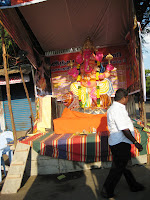
9/4/08--Kottivakum--my neighborhood
Some enchanted evening. Some women who have been here a year invited me to come over to dinner with them. Caroll’s apartment was airy with an American kitchen and good karma. We had a splendid meal, and I left on my bike to come home in the dark. I followed the loud music, and found a makeshift stage with an audience of about 100—children dancing in the dirt, women on one side, men on the other. In honor of Ganeesha I think. People doubled over with laughter at my appearance—I rode on past little shrines with people singing and chanting. When I turned into my neighborhood I saw in the streetlight a long table set up at the corner lot where the people live in the “little house.” The table was metal and could seat about 50. “Auntie! Auntie! Come my sister!” I was beaconed to join in the festivities. At first I thought it was a wedding. The young girl came out decked in jewels and a beautiful red sari—smiling and hugging each othe, I got out my camera. “OH! PHOTO!” she gasped! “Yes! Yes! Now come and eat!” I was seated next to the mother and served briani on a banana leaf topped with onions and garlic and spices. A large glass of water was poured for me—taboo, but who is to argue? It was a mountain of food, and I mixed it with my fingers and dug in. Delicious—the spices blending perfectly with the sharp edge of the onion. I had just eaten though. I ate slowly, wondering what to do with the rest? Finally, I pulled out my camera, which diverted the attention, and I stood up for the extended photo session. The girl was Asrani’s sister—14. My heart ached. “Where is your husband?”
“No, no, Uncle.” Snap. More with the baby. “Super beautiful was the cry when I replayed the pictures.” Everyone smiling—beaming. Finally Debbie Baby said in good English, “No Husband! No wedding! Birthday!” A sigh of relief from me. More photos—shot like mug shots in the dark. “You are my very special friend,” Asrani said as she hugged me good bye. I wondered at my good fortune to be invited twice for dinner in one night, and being served food by people with so little to have 2 night in a row. Ah, India.

I had a case of the blues over my birthday. I suppose it the accustomed ritual with friends and family that I missed so much. Earlier in the year we had graphed our birthdays in the classroom, and the kids asked mine and we added it to the graph. We have birthday circles for the children honoring them, giving them wishes from the heart. My birthday was a celebrated holiday in our classroom. The children made many surprises for me—little books, a big card. Esther (the teaching assistant) gave me a beautiful full skirt that’s green and bright yellow with sequins. Several children gave me small gifts from home. The kids told all of the other teachers it was my birthday and how old I am. A parent brought in a big cake and juice for all of us. I felt very loved and appreciated. That was Thursday.

 Friday, right after school Barbara, another new teacher and I caught a very full bus to Pondicherry to spend the week end. We sat next to a young man who lives in Texas, but was born in “Pondy.” He talked to us the whole way down. He had met his wife, who is from Chennai, in Utah. He told us about how upsetting it was to their families that they found each other, and that it wasn’t arranged. To make matters stickier, they are from different castes. IT took two years for them to convince their parents that this was a good idea. He explained that the Brahmin caste is considered a higher caste, but that they are the families which the priests come from, and now they are a poorer lot. Both of his parents teach at the University here—He didn’t say what her parents do in Chennai. He was so poised and friendly and the trip was over too quickly. We went back to the Park Guest House, where I had stayed the week before. We were met by a very small man who told us his name was, “Bond. James Bond.” He was very cryptic about signing us in. The next morning the old woman was back at the desk, next to a young woman. Last week she was very sour, but today she was very friendly. She recognized me and when I told her that I was having a lovely time, she responded, “Lovely people have lovely times.” Barbara and I set off and went to the Ashram of Aurobindo and the Mother. It was a beautiful spot, built around a big tree with a tank under it filled with arranged flowers. Flowers every where, and the people sat and meditated, hugged and touched the tree and prayed around the tank. I think it is so interesting how enlightened people are so revered to the point of worshipped and prayed to. I think Eckard Tolle and Thich Nat Han are enlightened people, and teach very much in keeping with Aurobindi and the Mother, but I can’t imagine praying to them, making temples and worshipping them. It is an interesting notion. There was a great book store where his poetry and writings are published in over 30 languages. I bought several small booklets.
We left the Ashram and went a few blocks over to the Elephant Temple,  where an elephant lives and blesses people. They sell grass and fruit and the people feed the elephant. He is not tethered, but stays there all the time. His head is painted beautifully and he looks you in the eye with his
  soulful ones. He places his trunk over your head when you bow to him. I fed him coconuts and grass and we caught a rickshaw to the settlement of Auroville.
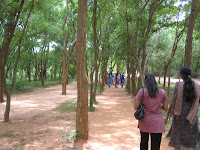 Auroville is 40 years old now. Aurobindo and the Mother took a barren spot of land and have
 planted over a million trees. It is a multinational community working on sustainability. They have many different schemes going. Paper making, art work, dance, cheese, health, and engineering. They use a lot of solar power. They do a lot of outreach to the neighboring villages. They recently got the bid to clean up and restore the Adyar River Estuary and bird sanctuary.
  The information center has a video about its history and then you can walk out to the Dome. Apparently, it has the world’s biggest crystal in it. You can only go in with written request and an appointment. We walked through beautiful young forests and an astounding stand of banyan trees. It was an impressive moment. No trash, and everything is so well kept up. They have a set of stores that sell clothing, musical instruments, and jewelry, soap, candles. There was a café where we had a wonderful luncheon. The goods sold there are like nothing I have seen anywhere else. Very classy and tasteful. Everyone in the community is considered a teacher, learner, artist and researcher. They produce beautiful stuff at European prices.
We stayed for a couple of hours and then put-putted back into Pondy where Barbara and I wandered crowded streets in the Tamil Nadu neighborhood and bought clothing for very little. Looking, shopping was an experience in itself. We found the Grand
 Bazaar, an inside fish market where hundreds of
 women clean and sell fish, shrimp, and all seafood imaginable. I wish these pictures could be scratch and sniff. The next layer in was fruit, and if you could stand to stay inside and wander further you found men selling spices from piles of colorful smells. We ate on the familiar rooftop and drank cold lime soda—tired from our walking.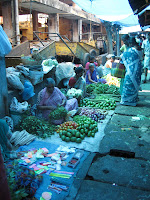

In the morning we swam in the ocean—rough and warm, a sensory delight. We even saw other teachers from Chennai—small country.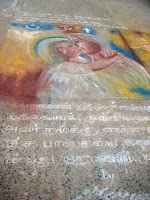
 After a quick tour through the city, we were shopped out and headed back to the city for a fund raising dinner a group was hosting to raise money for children affected by AIDS. It is a group home for 10 kids. It was my first big party of almost all Indians and they loved the entertainment and laughed and laughed. I left after eating on an early shift, and they were still going strong. Traveling here is exhausting somehow. I think it is the sensory overload of the simplest moments.
When I walked up to my house I noticed men climbing on a bamboo ladder and working on the mess of wires down the street—since then, no internet. How funny to be so dependent on something that wasn’t even available a short time ago. . . I am really missing people now. Hungry for any glimpse of home. (That’s a hint.)
Tonight I came home a long way on my bike, meandering different streets leisurely. I found the nicest surprise when I came home. Permeal, the guard, had dinner for me! Delicious food, some sort of dumplings, some savory, some sweet, egg pancakes, and sweet rice, spicy garbonzo beans. His wife made it for me, and he beamed when he gave it to me. So unbelievably generous and kind. We talk to each other a lot now, he in Tamil, I in English, and somehow we seem to understand comfortably. We drink cold lime water together everyday, and I have been sharing my dinner with him, and now he with me. What a world I live in.
Today is a day in honor of Ganeesha. The town is crazy with festivities which began at 4:30 a.m.